Vacuum Trips a Breaker? What the Manuals Cover
Short answer
The cited sources give model-specific no-power and thermal cut-out instructions; they do not identify why a vacuum trips a breaker or blows a fuse. As a precaution, stop using the vacuum after a breaker trips or a fuse blows, and seek advice from a qualified electrician or the manufacturer. The table below identifies the models and document behind each instruction.
Vacuum power loss: source limits and precautions
-
Check 1
Did a breaker trip or a fuse blow when you used the vacuum?
Yes
As a precaution, stop using it and contact a qualified electrician or the manufacturer. These sources do not diagnose breaker trips or blown fuses.
No
-
Check 2
Is there visible damage to the cord or plug?
Yes
As a precaution, stop using the vacuum, contact the manufacturer, and do not tape over damage or flex a plugged-in cord.
No
-
Check 3
Did the vacuum stop during use without a breaker trip or a blown fuse?
Yes
As a precaution, follow the shutdown instructions for your exact model in the table below; do not treat cooling as a remedy for a tripped breaker.
Open the guideNo
-
Check 4
Does the vacuum remain off after you have followed its model's instructions?
Yes
As a precaution, stop using it and contact the manufacturer; do not open the housing or fit a higher-rated fuse.
No
None of these?
As a precaution, ask an electrician about a dead outlet or tripped breaker, and the manufacturer about the vacuum; note its model number.
The cited manuals and support pages cover loss of power and thermal shutdown for the models listed below. They do not establish why an operating vacuum would trip a household breaker or blow a fuse. The table separates each source’s outlet, cord and thermal-protection instructions; it is not a diagnostic sequence for a tripped breaker.
What the sources say about outlets and supply
For the models listed on Hoover UK’s no-power page, including DM4468 and DM4476, the page mentions the main fuse or distribution-box trip as possible explanations for no power. It advises disconnecting the appliance before examination and seeking a competent electrician if the supply problem persists.
For the PowerForce Compact and CleanView Compact model numbers listed in the table below, BISSELL describes testing an outlet with a phone charger or small appliance. If the outlet has no power, its article suggests resetting the breaker if needed or trying another outlet. The article addresses a vacuum with no power; it does not explain a breaker trip.
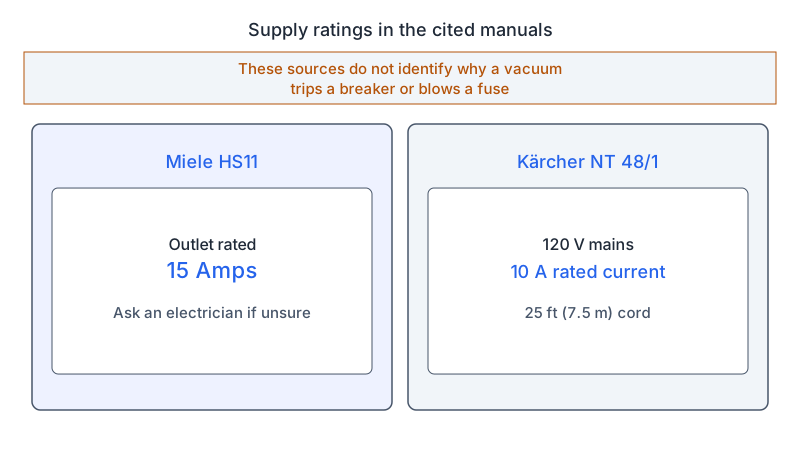
Miele’s en-US HS11 manual (M.-Nr. 11 787 241) states that the electrical outlet must be rated at 15 Amps. It also advises consulting a qualified electrician if you are not sure of your home’s voltage supply. Kärcher’s NT 48/1 technical data lists 120 V mains and a rated current of 10 A.
As a precaution, do not open an outlet, fuse box, distribution board or vacuum housing, repeatedly reset a tripping breaker, or replace a blown fuse with one of a higher rating.
Cord, plug and damage
BISSELL’s cord and plug steps for its compact uprights are set out in the no-start guide, so this section concentrates on what the other manuals state.
Miele’s en-US HS11 manual says not to use the vacuum if the power cord is damaged, and that a damaged cord must be replaced together with the cord reel by Miele Service or a Miele authorized service technician. The Numatic manual for the HVR370-11 models listed below asks that a cracked or ageing cord be replaced by a qualified person, and warns against pulling the cable to unplug the machine. Kärcher’s NT 48/1 safety list says not to use the machine if the cord, the plug, the filter or the vacuum itself is in poor condition.
The no-start checks for a machine that never responds are covered in the no-start guide. If the motor runs but pickup stays weak, use the no-suction guide.
Thermal shutdown instructions in the cited sources
The Hoover thermal cut-out page and the Miele HS11 manual describe shutdown caused by overheating for the models they cover. The Numatic HVR370-11 instructions mention a thermal protection device. These statements do not explain a household breaker trip. See also the overheating guide. The table below keeps each instruction with its source and models.
What changes by model
Each row cites one document and the models that document names.
| Brand and model | What the source gives on power | Source |
|---|---|---|
| Hoover UK, models listed on its thermal cut-out page | Unplug and check for blockages or dirty filters; about 45 minutes to cool; automatic reset once cooled and plugged back in | Hoover UK thermal cut-out page |
| Hoover UK, models listed on its no-power page, including DM4468 and DM4476 | Socket switch, isolator switch, fuse box, main fuse or trip in the distribution box; competent electrician if the supply stays off | Hoover UK no-power page |
| BISSELL PowerForce Compact 1520, 2112, 21123, 2690; CleanView Compact 3508, 3437, 34362, 3436 | Cord and plug check with the machine unplugged; outlet test with a small appliance; reset the breaker if needed or try another outlet | BISSELL no-power article |
| Miele HS11 canister (en-US, M.-Nr. 11 787 241) | Outlet rated at 15 Amps; temperature limiter; switch off, unplug and remove the cause, then allow about 20 to 30 minutes to cool before restarting; cord fully extended for vacuuming sessions longer than 30 minutes | Miele HS11 manual |
| Numatic HENRY XL, HETTY XL PLUS, HENRY XL PLUS, HENRY HOME XL, HENRY PET XL (HVR370-11), UK | Thermal protection device; remove the plug from the wall before investigating; mains lead HO5-V2V2-F, 12.5 m, 2 core, 1.00 mm² | Numatic manual |
| Kärcher NT 48/1 (59789930, 05/23) | For a suction turbine that does not start: switch off, unplug, check the socket and power supply fuse, check the cable and plug, then switch on; 120 V, 10 A; 25 ft (7.5 m) cord | Kärcher NT 48/1 manual |
Hoover UK
Hoover’s thermal cut-out page says the cut-out switches the power off when the cleaner overheats, and that blockages or dirty filters may cause this. Its steps are to unplug the cleaner, check for blockages or dirty filters, and allow about 45 minutes to cool. The page says the cut-out resets automatically once the cleaner has cooled and been plugged back in. It lists model codes such as DM4468, DM4476 and HU4177T. This is UK guidance from the Hoover UK service site.
BISSELL: PowerForce and CleanView Compact
The article covers the model numbers listed in the table above. Its sequence begins with the unplugged cord, moves to the plug, and ends at the wall outlet and breaker.
Miele HS11
The HS11 manual describes a temperature limiter that switches the vacuum off automatically when it gets too hot. Its steps are to switch off with the On/Off foot switch, unplug, remove the cause, and wait about 20 to 30 minutes before turning it on again. The same manual says the power cord may overheat after long use, and that if vacuuming runs for longer than 30 minutes the cord must be pulled out all the way.
Numatic HENRY XL range (UK)
The combined Numatic instructions name the HENRY XL, HETTY XL PLUS, HENRY XL PLUS, HENRY HOME XL and HENRY PET XL (HVR370-11). They state that the vacuum is fitted with a thermal protection device, and that if it stops working the plug should be removed from the wall before any investigation. The manual also says the machine must be disconnected by removing the plug during cleaning, maintenance or parts replacement.
Kärcher NT 48/1
The NT 48/1 manual (59789930, 05/23) gives a sequence for a suction turbine that does not start: switch off the device, remove the mains plug, check the socket and the power supply fuse, check the mains cable and plug, then switch on. Its technical data lists 120 V mains, a rated current of 10 A and a 25 ft (7.5 m) SJTW-A 2/16 AWG cord. The NT 48/1 safety list also requires disconnection before maintenance and when the vacuum is not in use, and says not to leave it unattended while plugged in. The NT 48/1 manual’s English safety item 12 specifies recommended attachments, with no electrical extension-cord requirement stated in that item.
Frequently asked questions
Does a vacuum reset by itself after a thermal shutdown?
For the models listed on Hoover UK’s thermal cut-out page, including DM4468, DM4476 and HU4177T, the cut-out is designed to reset automatically after cooling and reconnection. Miele’s en-US HS11 manual says to switch off, unplug and remove the cause, then allow about 20 to 30 minutes to cool before turning the vacuum on again.
When should I stop and call for help?
As a precaution, stop using the vacuum and contact its manufacturer for cord or plug damage, or a qualified electrician for a dead outlet or a breaker that trips again. The Numatic HVR370-11 manual calls for a qualified person to replace a damaged cord. Miele’s en-US HS11 manual requires replacement of the cord together with its reel by Miele Service or a Miele authorized service technician.
Not sure which guide fits? Use the symptom checker
Checked against
Models checked: Hoover UK models listed on its thermal cut-out and no-power pages (UK); BISSELL PowerForce Compact 1520, 2112, 21123, 2690 and CleanView Compact 3508, 3437, 34362, 3436; Miele canister HS11 (en-US, M.-Nr. 11 787 241); Numatic HENRY XL, HETTY XL PLUS, HENRY XL PLUS, HENRY HOME XL, HENRY PET XL (HVR370-11) (UK); Kärcher NT 48/1 (59789930, 05/23). These are document checks, not hands-on tests.
- Hoover UK: The vacuum cleaner cuts out during use (support; accessed )
- Hoover UK: Check there is electricity at the socket (support; accessed )
- BISSELL: PowerForce and CleanView Compact Upright No Power (support; accessed )
- Miele: Canister Vacuum Cleaner Operating Instructions (en-US, HS11) (manual; accessed )
- Numatic: HENRY XL, HETTY XL PLUS, HENRY PET XL Original Instructions (manual; accessed )
- Kärcher NT 48/1 operating instructions (59789930, 05/23) (manual; accessed )