Wet/Dry Vac Stops Sucking: Manual Notes by Model
Short answer
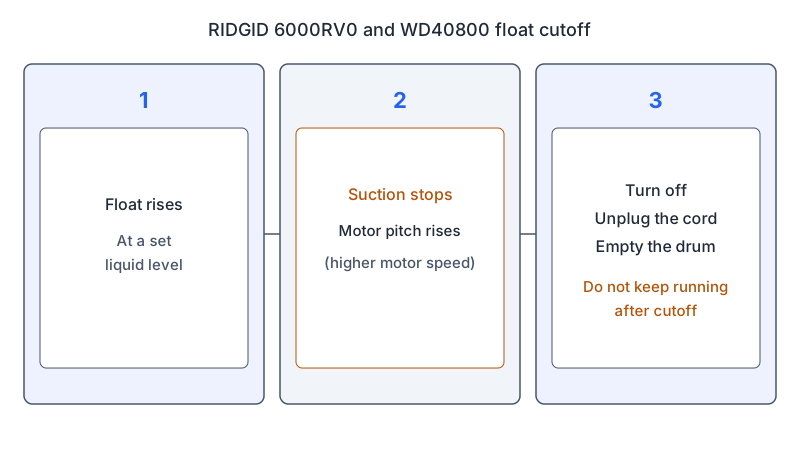
On the RIDGID 6000RV0 and WD40800, a float cuts airflow at a set liquid level and the motor pitch rises. Switch off, unplug and empty the drum when this happens. As a precaution, use the procedure for your exact model below.
Wet/dry vac losing suction: checks by model
-
Check 1
On a RIDGID 6000RV0 or WD40800, did suction stop and the motor pitch rise as the drum filled with liquid?
Yes
Switch off, unplug the power cord and empty the drum. Do not keep running after the float has cut suction.
No
-
Check 2
On a DeWalt DWV010 or DWV012, has the motor sound turned high-pitched while air and water flow stopped?
Yes
Turn off, unplug and empty the canister, as the DeWalt manual instructs.
No
-
Check 3
On a Kärcher WD 2 Plus / WD 3 or WD 5, did the device run faster after the container filled?
Yes
Switch off immediately and empty the container.
No
-
Check 4
On a Kärcher WD 2 Plus / WD 3, did suction stop after the device fell over?
Yes
Set the device upright, switch it off, wait 5 seconds, then switch it on again.
No
-
Check 5
On a Kärcher WD 2 Plus / WD 3 or WD 5, has suction declined because an accessory, hose or tube is clogged?
Yes
WD 2 Plus / WD 3: remove the clog with a suitable aid. WD 5: remove the obstruction using a stick.
Open the guideNo
-
Check 6
On a DeWalt DWV010 or DWV012, has the vacuum stopped running?
Yes
Turn off, unplug, empty the canister if needed and let it cool. Plug in and test. If it will not restart, call DeWalt.
Open the guideNo
None of these?
As a precaution, do not bypass safety devices; stop using the vacuum and contact its manufacturer if checks for your model do not restore suction.
Why suction stops on the models named here
The manuals cited here describe a float that cuts suction when the container reaches a set level or is full. On the RIDGID 6000RV0 and WD40800, suction stops and the motor pitch rises. On the DeWalt DWV010 and DWV012, a ball float valve blocks air to the motor when the canister is full. On the Kärcher WD 2 Plus / WD 3 and WD 5, a float closes the suction opening when the container is full. The sections below give each model’s wording and the steps its own manual lists.
What changes by model
The table has one row per manual, and each model name links to its document.
| Model | What the manual says happens | Documented step |
|---|---|---|
| Kärcher WD 2 Plus / WD 3 | A float switch closes the suction opening and the device runs at a higher speed when the container is full | Switch off immediately and empty the container |
| Kärcher WD 5 | A float closes the suction opening and the appliance works at a higher speed when the container is full | Switch off the appliance immediately and empty the container |
| DeWalt DWV010 | The ball float valve blocks air to the motor when the canister is full, and the motor sound changes at once | Turn off, unplug, unlatch the canister and empty it |
| DeWalt DWV012 | The ball float valve blocks air to the motor when the canister is full, and the motor sound changes at once | Turn off, unplug and empty the canister |
| RIDGID 6000RV0 | The float rises at a predetermined liquid level, suction stops and the motor noise becomes higher in pitch | Turn off, unplug the power cord and empty the drum |
| RIDGID WD40800 | The float rises at a predetermined liquid level, airflow ceases and the motor noise becomes higher in pitch | Turn off, unplug the power cord and empty the drum |
Kärcher
The WD 2 Plus / WD 3 operating instructions, document 59510380 (05/23), name WD 2 Plus / WD 2 Plus S and WD 3 / WD 3 S / WD 3 P / WD 3 P S on the cover. Its full-container section reads: “When the container is full, a float switch closes the suction opening and the device runs at a higher speed. Switch off the device immediately and empty the container.” For these models, the manual adds: “If the device falls over, the float can also close. To make the device capable of vacuuming again, set up the device, switch it off, wait 5 seconds and then switch it on again.”
The WD 5 operating instructions, document 59687950 (02/19), name the model WD 5. Its wet-vacuuming note reads: “If the container is full, a float closes the suction opening, and the appliance works at a higher speed. Switch off the appliance immediately, and empty the container.”
For declining suction, the WD 2 Plus / WD 3 manual lists clogged accessories, suction hose or suction tubes (“Remove the clog with a suitable aid.”), a full filter bag (“Replace the filter bag.”) and a dirty foam or cartridge filter to clean, followed by a damaged filter to replace (“Replace the foam filter / cartridge filter.”). The WD 5 manual lists a clogged accessory or hose, a full filter bag and a contaminated flat fold filter.
On the WD 2 Plus / WD 3, the manual says: “Do not use a filter bag when vacuuming wet.” It also says: “Always ensure that the foam or cartridge filter is inserted, for both wet vacuuming and dry vacuuming.” The WD 5 manual says: “Note: Do not use a filter bag for wet vacuuming!” WD 5 requires its flat fold filter for wet and dry pickup. Both Kärcher manuals require dry filters for dry pickup and complete drying after washing.
DeWalt
The DWV010 instruction manual names the DWV010 on its cover. Its float passage reads: “The ball float valve (R) will block air to the motor when the canister is full and the sound of the motor will change at once. When the motor has a high pitched sound and air/water flow stops, empty the canister.” A notice adds: “DO NOT remove ball float (R), doing so will cause damage to the vacuum.” Its suction table lists “Remove blockages in the suction nozzle, suction tube, suction hose or filters.” Its thermal-overload entry says to turn the vacuum off and disconnect it, empty the canister if needed, allow the unit to cool, then plug in and test. If it will not restart, the manual gives 1-800-4-DEWALT.
The DWV012 instruction manual names the DWV012 on its cover. This PDF sits on DeWalt’s Spanish-language support site (the hc/es path), and its English text is quoted here. Its float passage uses the same wording with ball float valve (V), and its notice reads: “DO NOT remove ball float (V), doing so will cause damage to the vacuum.” Both DeWalt suction tables list blockage removal, bag replacement, filter-installation checks, filter cleaning or replacement, and canister emptying, in that order. Its thermal-overload entry matches the DWV010 steps. The manual also describes the DWV9402 fleece bag, which “should be disposed of once the airflow becomes restricted. DO NOT reuse this bag.”
RIDGID
The RIDGID 6000RV0 owner’s manual names the 6000RV0 on its cover. Its liquid section says the float mechanism “will rise automatically to cut off air-flow. You will know that the float has risen because suction stops and the motor noise will become higher in pitch, due to increased motor speed. When this happens, turn off the Vac, unplug the power cord, and empty the drum.”
The WD40800 owner’s manual names the WD40800 and gives the same float description, saying that “Vac airflow ceases”. Its contents list includes the Qwik Lock™ Filter, VF3500.
On the 6000RV0, the filter guidance depends on the amount of liquid. For large amounts, the manual says: “it is recommended that the filter be removed. If the filter is not removed, it will become saturated and misting may appear in the exhaust.” The WD40800 manual says: “we recommend that the filter be removed.” Both manuals say the filter must be dried after liquid pickup “to avoid possible mildew and damage to the filter.”
Both manuals also warn: “Do not continue running when float has cut off suction.” and “Do not operate without filter cage and float, as they prevent liquid from entering the impeller and damaging the motor.”
Checks by symptom and model
- Suction stops and the motor pitch rises during liquid pickup. On the RIDGID 6000RV0 and WD40800, turn off, unplug the power cord and empty the drum. On the DeWalt DWV010 and DWV012, empty the canister when the motor sound turns high-pitched and air or water flow stops. On the Kärcher WD 2 Plus / WD 3 and WD 5, switch off immediately and empty the container.
- Kärcher WD 2 Plus / WD 3 after a fall. The manual says the float can close after a fall. Set the device up, switch it off, wait 5 seconds and switch it on again.
- Declining suction. On the DeWalt DWV010 and DWV012, clear blockages in the nozzle, tube, hose or filters, and replace the paper or fleece bag. On the Kärcher WD 2 Plus / WD 3, remove the clog with a suitable aid, replace a full filter bag, clean a dirty foam or cartridge filter, and replace a damaged filter. On the WD 5, clear the obstruction with a stick, insert a new filter bag, and clean a contaminated flat fold filter. For other suction problems, see the no-suction guide and the hose-clog guide.
- RIDGID 6000RV0 filter wet after liquid pickup. The filter can saturate and produce exhaust mist. The manual recommends removing it for large amounts of liquid and requires a dry filter for dry pickup.
- DeWalt DWV010 or DWV012 stops running. Follow the thermal-overload steps above. For a related procedure, see the overheating guide.
As a precaution, unplug the vacuum before inspecting any part.
Manufacturer contact information and precautions
As a precaution, if the checks for your model do not restore suction, stop using the vacuum and contact its manufacturer. The DeWalt manuals give 1-800-4-DEWALT (1-800-433-9258) for a vacuum that will not restart after cooling. For a general list of fault routes, see the corded vacuum troubleshooting hub.
The DeWalt manuals say not to remove the ball float, and the RIDGID manuals say not to operate without the filter cage and float.
Frequently Asked Questions
What does a higher motor pitch indicate on these models?
The RIDGID 6000RV0 and WD40800 manuals tie a higher motor pitch to the float rising. The DeWalt manuals describe a high-pitched motor sound, with air or water flow stopped, as the sign to empty the canister. The Kärcher WD 2 Plus / WD 3 and WD 5 manuals describe a higher running speed when the float closes.
What do the DeWalt and RIDGID manuals say about the float?
The DeWalt DWV010 and DWV012 manuals say not to remove the ball float, because doing so damages the vacuum. The RIDGID 6000RV0 and WD40800 manuals say not to operate without the filter cage and float.
What does the Kärcher WD 2 Plus / WD 3 manual say after a tip-over?
The WD 2 Plus / WD 3 manual says to set the device up, switch it off, wait 5 seconds and switch it on again.
Not sure which guide fits? Use the symptom checker
Checked against
Models checked: Kärcher WD 2 Plus / WD 3, operating instructions 59510380 (05/23); Kärcher WD 5, operating instructions 59687950 (02/19); DeWalt DWV010 instruction manual; DeWalt DWV012 instruction manual; RIDGID 6000RV0 owner's manual; RIDGID WD40800 owner's manual. These are document checks, not hands-on tests.
- Kärcher WD 2 Plus / WD 3 operating instructions, 59510380 (05/23) (manual; accessed )
- Kärcher WD 5 operating instructions, 59687950 (02/19) (manual; accessed )
- DeWalt DWV010 heavy-duty dust extractor instruction manual (manual; accessed )
- DeWalt DWV012 heavy-duty dust extractor instruction manual (manual; accessed )
- RIDGID 6000RV0 6 gallon wet/dry vac owner's manual (manual; accessed )
- RIDGID WD40800 4 gallon detachable wet/dry vac owner's manual (manual; accessed )