Floor Washer Not Picking Up Water? Check the Dirty Tank
Short answer
Match the symptom to your model: BISSELL's CrossWave Cordless Max sheets cover no suction and false full-tank alerts, Tineco iFloor 2 Max has its own self-clean checks, and the Roborock WD1S1A manual lists clogs in the dirty water pipe. Follow the procedure for your exact machine.
Floor washer not picking up water: checks by model
-
Check 1
Are your Tineco iFloor 3 floater, filter or dry filter clogged?
Yes
Clean the floater, wash the filter and dry filter with water, and keep the filters completely dry before refitting.
No
-
Check 2
Does your Tineco iFloor 2 Max fail to pick up water in self-clean mode?
Yes
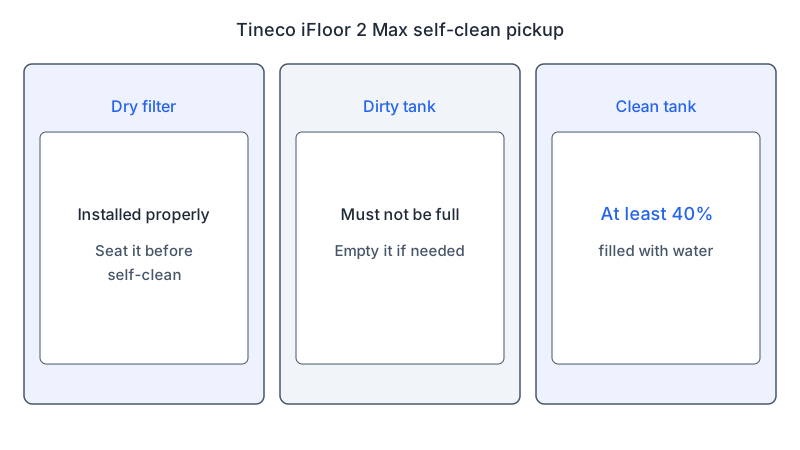
Check that the dry filter is installed properly, the dirty tank is not full and the clean tank is at least 40 percent filled.
No
-
Check 3
Does your BISSELL CrossWave Cordless Max show a full-tank alert with the tank not full?
Yes
Clean the float sensors under the dirty tank lid with a damp cloth and let them dry completely before refitting the tank.
No
-
Check 4
Does your BISSELL CrossWave Cordless Max have no suction and a damaged filter?
Yes
Order a replacement filter, and clear any clogs in the debris pathway in the dirty tank pocket before refitting.
No
-
Check 5
Does your eufy WetVac have no suction for debris or liquid?
Yes
Check the filter sponge bracket, remove the rolling brush and clear debris from the suction inlet with the cleaning tool.
No
-
Check 6
Does your Roborock WD1S1A stop picking up dirty water from the floor?
Yes
Remove the rollers and dirty tank, clear the dirty water pipe and suction outlet, clean the filter, then refit and retry.
No
None of these?
As a precaution, contact support if your model's checks do not restore pickup; eufy asks for videos of persistent suction faults.
The short answer
The checks depend on the brand, the model and the mode in use. BISSELL’s support sheets for the CrossWave Cordless Max cover both a false full-tank alert and a no-suction fault. Tineco’s iFloor 2 Max page treats water pickup during self-clean as its own case, and Tineco’s iFloor 3 page asks about clogs in the floater and filters. Roborock’s WD1S1A manual points to clogs in the dirty water pipe and suction outlet. Use the procedure for your exact model before you clean parts or order a replacement.
Identify what the machine is doing
As a precaution, record the alert and operating mode before opening any part: a full-tank warning, weak pickup during floor cleaning, or water left during self-cleaning. Tineco’s iFloor 2 Max page treats self-clean as its own case, so a fault that appears only in self-clean mode should be checked against that mode’s conditions.
If the machine loses suction on dry debris rather than wet pickup, see the cordless suction guide. For a robot mop that leaves water behind, see the robot mop puddles guide. For streaks left after a wet pass, see the streaks guide, and for a unit that drips, see the leaking water guide.
What changes by model
Each brand documents its own checks for this symptom. The table lists the dirty-water step that each source describes. Every row links to the page or sheet it comes from.
| Model | Dirty-water check the source describes | Source |
|---|---|---|
| Tineco iFloor 3 | Check whether the floater, filter and dry filter are clogged; clean the floater, wash the filters with water, and keep them completely dry before refitting | Tineco iFloor 3 troubleshooting |
| Tineco iFloor 2 Max | In self-clean mode, check that the dry filter is installed properly, the dirty tank is not full and the clean tank holds at least 40 percent water | Tineco iFloor 2 Max troubleshooting |
| BISSELL CrossWave Cordless Max | Full-tank alert with the tank not full: clean and dry the float sensors on the lid. No suction: clear debris from the suction pathway and the dirty tank pocket, and order a replacement if the filter is damaged | BISSELL dirty tank sheet and BISSELL no-suction sheet |
| eufy WetVac | Check the filter sponge bracket is correctly installed, remove the rolling brush, and clear debris from the suction inlet with the cleaning tool | eufy WetVac article |
| Roborock WD1S1A | Remove the rollers and the dirty tank, check the dirty water pipe and suction outlet for clogs, clean the filter, and confirm the dirty tank and filter are properly installed | Roborock user manual |
Tineco
Tineco provides separate troubleshooting pages for the iFloor 3 and iFloor 2 Max issues covered here. On the iFloor 3, the page for reduced suction and failure to pick up asks whether the floater, filter and dry filter are clogged. Its solution is to clean the floater and to wash the filter and dry filter with water. The page also asks you to confirm that the dry filter is installed properly, and to make sure the filters are completely dry before reinstalling them.
On the iFloor 2 Max, the self-clean section covers the case where the machine cannot pick up water in self-clean mode. The page directs you to three conditions: the dry filter is seated correctly, the dirty water tank is not full, and the clean water tank has at least 40 percent water. It also cautions against pressing the trigger when checking any part of the machine, unless a prompt asks you to do so.
BISSELL CrossWave Cordless Max
BISSELL publishes two support sheets for this model, and they cover different faults. The dirty tank sheet starts with the case where the orange dirty water tank full light is on while the tank is not full. For that case it says to turn the machine off, remove it from the dock, press the recessed button on top of the dirty tank, lift the tank top off, and remove the filter. The filter and screen are hand-washed in warm water. The sheet directs you to clean the float sensors on the bottom of the lid with a damp cloth and let them dry completely, because the sensors need to be dry to work. It also says to wipe the gold sensors on top of the lid with a dry tissue, and to remove the strainer, discard debris and rinse it.
The no-suction sheet covers a different branch. It asks you to check for suction at the foot behind the brush roll, to clear debris from that pathway, and to clean the brush roll and its window. If suction is still low, it has you remove the strainer and the filter, inspect the filter for tears or damage, and clear any clogs in the debris pathway in the dirty tank pocket. It recommends hand-washing the filter, screen and float indicators in warm water and allowing 24 hours to dry. When refitting, the tank should not be loose and should have no gaps.
eufy WetVac
The eufy article on a WetVac with no suction power gives a short sequence. According to the page, you check that the filter sponge bracket is correctly installed, remove the rolling brush by lifting its fixing bracket, and check whether the suction inlet is blocked by debris. If it is, the cleaning tool removes the debris from the inlet. If the problem continues, the article asks you to contact eufy support with videos showing the issue.
Roborock WD1S1A
The Roborock manual for the wet and dry vacuum cleaner, model WD1S1A, has a common-issues table. Its entry for “Dirty water is not vacuumed from the floor” says to remove the rollers and the dirty tank to check for a clog in the dirty water pipe or the suction outlet, and to check whether the filter is clogged. It then says to clear all blockages, clean the filter, and make sure the dirty tank and filter were properly installed before retrying. The troubleshooting table gives the error “Error. Clear any blockages in the cleaning head and restart.”
The maintenance section lists the dirty tank and filter for weekly cleaning. It says to rinse the filter with cold water and “Allow up to 24 hours for filter drying.” It also asks you to clean the roller brush slot and dirty water pipe with the maintenance brush, and says “Do not wash the cleaning head directly with water.”
Practical checks for the dirty-water path
As a precaution, use only the checks that match your model and symptom, and switch the machine off before removing parts or clearing debris.
- Tank seating. On the BISSELL CrossWave Cordless Max, angle the tank back in with its bottom edge leading and push until it clicks, with no looseness or gaps. On the Roborock WD1S1A, refit the filter cartridge and cover, then tilt the dirty tank upward until it locks in place.
- Float and sensors. On the BISSELL CrossWave Cordless Max, dry the float sensors completely before refitting the lid. On the Tineco iFloor 3, clean the floater.
- Filter drying. On the Tineco iFloor 3, the filters must be completely dry before reinstalling. On the BISSELL CrossWave Cordless Max, the filter should be completely dry before reassembling, and the no-suction sheet recommends 24 hours for hand-washed parts. On the Roborock WD1S1A, the manual allows up to 24 hours for filter drying.
- Debris pathway. On the BISSELL CrossWave Cordless Max, clear clogs in the dirty tank pocket. On the Roborock WD1S1A, clean the roller brush slot and dirty water pipe. On the eufy WetVac, check the suction inlet.
- Self-cleaning. On the Tineco iFloor 2 Max, check the three self-clean conditions listed above. On the Roborock WD1S1A, the manual says to empty the dirty tank after self-cleaning and to place the vacuum on the dock after use to prevent water stains.
When to contact the manufacturer
As a precaution, contact the manufacturer with the model number and the alert shown if the checks for your model do not restore pickup. eufy’s article asks for videos showing a persistent suction problem. The Roborock manual lists after-sales contacts by region, says warranty services may not be available if unauthorized replacements are used, and says a warranty claim needs the original bill of purchase with its date.
Questions readers ask
Should I wash the float or only the tank? For the BISSELL CrossWave Cordless Max, the two sheets cover different parts. The dirty tank sheet asks you to dry the float sensors on the lid completely, and the no-suction sheet recommends hand-washing the float indicators in warm water. The Roborock manual lists its dirty tank and filter for weekly cleaning.
How long should a washable filter dry? The BISSELL CrossWave Cordless Max no-suction sheet recommends allowing 24 hours after hand-washing the filter, screen and float indicators. The Roborock WD1S1A manual allows up to 24 hours for filter drying. The Tineco iFloor 3 page asks for filters to be completely dry before reinstalling them.
For dry debris rather than wet pickup, see the cordless troubleshooting hub. For a shop wet/dry vacuum that has stopped sucking, see the wet/dry vac guide. For the general troubleshooting sequence across wet/dry vacuum mops, see the wet/dry vacuum mop troubleshooting guide.
Not sure which guide fits? Use the symptom checker
Checked against
Models checked: Tineco iFloor 2 Max; Tineco iFloor 3; BISSELL CrossWave Cordless Max; eufy WetVac; Roborock WD1S1A. These are document checks, not hands-on tests.
- Tineco Support: Troubleshooting for iFloor 2 Max (Support For iFloor 2 Max) (support; accessed )
- Tineco Support: Troubleshooting Guide for iFloor 3 (support; accessed )
- BISSELL: CrossWave Cordless Max, cleaning the dirty water tank (dirty water tank, filter and float indicator maintenance) (support; accessed )
- BISSELL: My CrossWave Cordless Max has no suction (support; accessed )
- eufy: What should I do if my WetVac does not have any suction power? (support; accessed )
- Roborock Wet and Dry Vacuum Cleaner User Manual (model WD1S1A) (manual; accessed )